
Dyslexia
What is dyslexia?
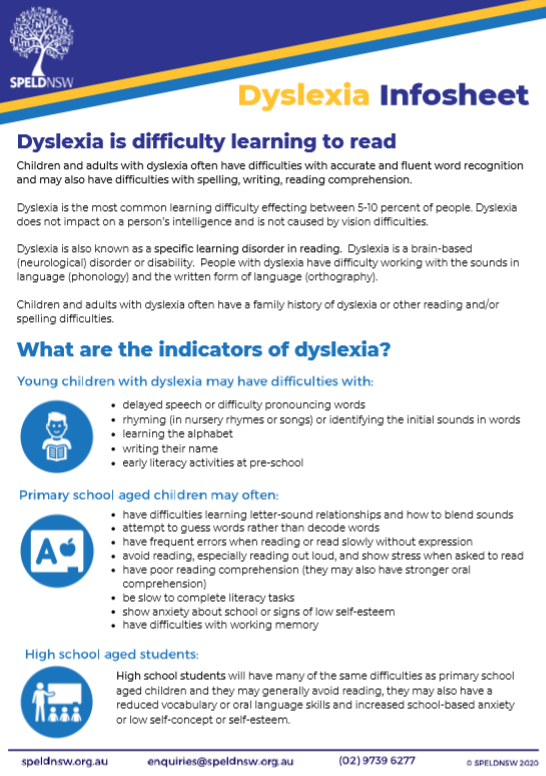
Dyslexia is a difficulty learning to read.
Children and adults with dyslexia often have difficulties with accurate and fluent word recognition and may also have difficulties with spelling, writing and reading comprehension.
Dyslexia is the most common learning difficulty impacting between 5-10 percent of people. Dyslexia also often runs in families. Dyslexia does not impact on a person’s intelligence and is not caused by vision difficulties.
Dyslexia is also known as a specific learning disorder in reading. Dyslexia is a brain-based (neurological) disorder or disability. People with dyslexia have difficulty working with the sounds in language (phonology) and the written form of language (orthography).
How is dyslexia identified?
Dyslexia is generally diagnosed by a psychologist. The psychologist will investigate learning strengths and difficulties.
Before a diagnosis of a specific learning disorder in reading (or dyslexia) is able to be made, it is essential that the child or adult being assessed has received at least six months of intervention focused on improving their reading skills.
Before seeking an assessment or diagnosis of dyslexia it is also important to check eyesight and hearing.
How do you support a person with dyslexia?
Students with dyslexia can improve their reading and spelling skills. Such students benefit from explicit and structured instruction in phonemic awareness and phonics (systematic synthetic phonics) along with the other essentials skills for reading (oral language, fluency, vocabulary and comprehension).
Students with dyslexia will generally need lots of opportunities to practise reading and spelling skills and so can benefit from working with learning support teachers, systematic synthetic phonics intervention programs or working with experienced tutors or speech pathologists. Decodable readers are an essential tool for students with dyslexia while they are learning to read.
Students and adults with dyslexia can also benefit from adjustments made to their school or work environments. Such adjustments include:
- the use of audio books and text to speech software;
- limits to the amount of reading and writing required;
- assistance with spelling, writing and editing for example, predictive spelling, scaffolded writing tasks, speech to text software.
More information about dyslexia

Dyslexia Awareness Month
October is Dyslexia Awareness Month – a time to come together to raise awareness, share resources, and tell stories about dyslexia successes.
Make a difference by supporting SPELD NSW. Help us raise awareness by sharing our free digital resources as well as raise vital funds to support students with dyslexia and learning difficulties. No amount is too small—every contribution counts!
Register for one of our Dyslexia Aware webinars. Or share our free digital resources! This is your chance to spread awareness and make an impact in your community.
Dyslexia Awareness Month
Join us each October to raise dyslexia awareness and support the 1 in 10 children who struggle to learn to read!
Dyslexia Aware Webinars
Develop a broader understanding of learning difficulties with four practical webinars. Learn when and where difficulties can occur and explore practical ways to support students in classrooms, intervention settings and at home.

Understanding Blending for Word Reading

Assistive Technology for Reading and Writing

Understanding and Responding to Reading Difficulties, including Dyslexia

Understanding and Responding to Writing Difficulties, including Dysgraphia
Understanding Dyslexia - Free Member Webinar
This free Understanding Dyslexia webinar, available exclusively to SPELD NSW Members, is perfect for parents, teachers, educators, allied health professionals, and schools. Membership provides ongoing access to high-quality learning throughout the year.


Sign up to SPELD NSW Enews for alerts about parent and teacher workshops

Call the SPELD NSW InfoLine to chat confidentially to our friendly support team or for a referral to a tutor

Book an educational assessment with a SPELD NSW Psychologist

Join SPELD NSW to support us in our work advocating for students and adults with dyslexia